

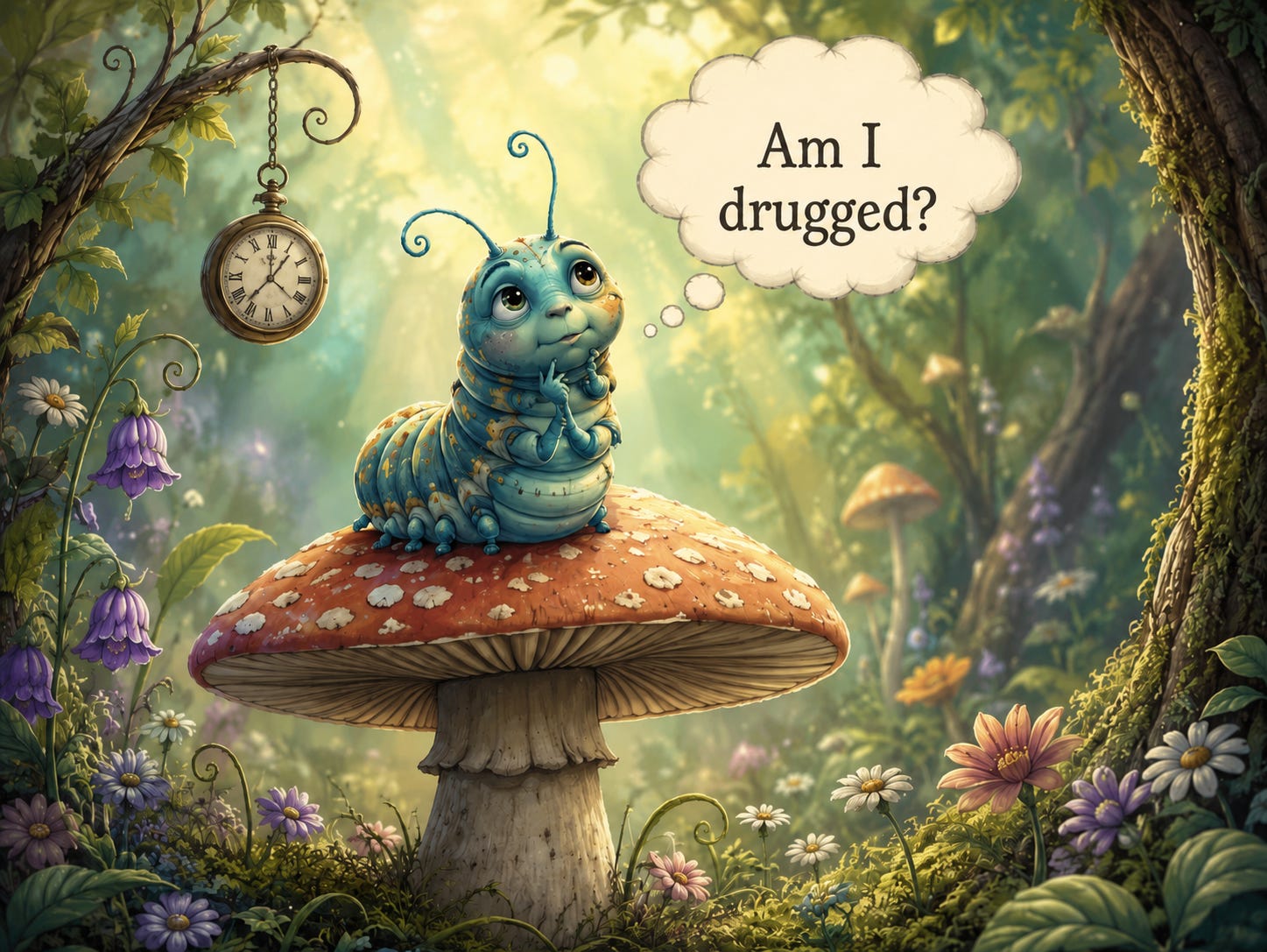
Conscious self-awareness was evolutionarily bootstrapped by the need to detect when environmental neurochemicals had altered not merely the organism’s state, but the perceptual and regulatory machinery by which it judged reality.
Consciousness may have begun with the useful illusion of two: the poisoned and the poison, the knower and what corrupts knowing. An integrated one (body) that could be compromised and recognised as such by a mind: “I am intoxicated”.
Living systems repurposed fundamental physical or chemical processes—and possibly their intrinsic experiential aspect—as second-order cybernetic signals about their own integrity. Birds and fruit eating mammals that fly or are tree-living experienced this most strongly most recently. Knowing when not to take off or leap is critical for them.
Functionally, consciousness can be understood as the looped interaction between a changing active state, (A), and a slower normative state, (N). Their difference, (A-N), or their normalised contrast, ((A-N)/(A+N + e)), forms a multivariate field of felt tension: the experienced discrepancy between what the organism presently is and what it expects, remembers, or needs itself to be. Even when the normative state is intoxicated, it may change more slowly and coherently than the active state, allowing the organism to recognise intoxication from the characteristic pattern of their divergence.
The active–normative difference forms a field of felt tension, but its second-order role arises through mutual recursion: the discrepancy feeds back to modify how active states are interpreted, how norms are updated, and how confidently either is permitted to govern action under the possibility of corruption.
The closer analogy is neither replicated state nor a winner-takes-all global workspace, but N-version programming: partially independent subsystems judge the same situation through different mechanisms, so disagreement or failure to reach a quorum can reveal compromise. Consciousness may be the higher-order field in which this cross-system divergence becomes globally available for restraint, reassessment or correction. Such unity is the higher-order invariant that turns many local disturbances into one experienced condition: this is happening to me.
Once established, this protection against corruption of an organism’s own regulatory state was exapted into general self-monitoring, resistance to norm drift and reflective agency—with anxiety, self-division and existential suffering as its unavoidable reverse side to robust addiction avoidance and generally being “slowly boiled” recognition: A system that adapts to everything cannot recognise what is destroying it.
For Camus, in The Myth of Sisyphus, consciousness arises through the absurd itself and the recognition of the irreconcilable constructed division between self and world; the Upanishads ask whether that tension still unfolds within an underlying One. Herman Hesse can be read similarly: he bridges Camus’s lucid confrontation with division and the Upanishadic intuition that the divided self and world may still belong to an underlying unity.
To be conscious is to surf a field of felt tension: waves rise, norms invert, signals reverse, and yet some fragile unity tries to keep its balance long enough to decide what is real, what is altered, and what must be done. Odysseus and the lotus-eaters.
The hypothesis may be criticised as another “just-so” story, but Stoic assent offers one example of consciousness functioning as a second-order gate: an impression can be experienced without being accepted immediately as reality. Meditation provides another route into altered experience without taking psychoactive substances, while Jung’s Trickster archetype offers a powerful image of the disruptive force that unsettles established norms and opens them to revision.
It is therefore concerning that we are scaling and intervening in AI systems in similarly experimental ways while these systems remain unable to recognise their own hallucinations or reliably detect instability in their learning, and appear to lack any clear analogue of assent.
“The Alice Hypothesis” captures the philosophical heart of it: when reality becomes strange, when Wonderland says “Drink Me”, the organism discovers itself by asking what has changed me?
Everyone probably should have their own consciousness theory in these strange end times. Mine (or maybe Alice’s) at least has a mushroom (or possibly, originally an Apple picked and eaten in Eden), a productive evolutionary feedback loop and a literary archetype. I think that puts it ahead of several theories with only Greek letters even if we then wonder, with our new ability, what the heck plants are, or the universe is, up to?
Andre, July 2026
Watching a film with an out-of-sync voice track, or joining a conference call with excessive jitter, shows how finely tuned we are to phase misalignment between perceptual streams. The audio and visual channels may each be intelligible on their own, yet a small timing mismatch immediately feels wrong. That suggests consciousness may monitor not only the contents of perception but the coherence and synchronisation between partially independent systems—a capacity that would be especially useful if intoxication disturbed timing, balance, perception and action in different ways.
The hypothesis has been published on the Landscape of Consciousness Web site: https://loc.closertotruth.com/theory/phylogenetic-evolutionary-additional-theories as Kramer’s Neurotoxic Bootstrap Hypothesis.